


Affiliate Disclosure: FactsnFigs is reader-supported. When you purchase secure networking hardware or VPN subscriptions through links on our site, we may earn an affiliate commission at no extra cost to you.
For remote teams handling proprietary source code, unreleased financial reports, or unredacted client databases, classical encryption is operating on borrowed time. Nation-state adversaries and state-sponsored APT groups are aggressively executing “Harvest Now, Decrypt Later” (HNDL) campaigns—scraping and storing massive volumes of AES and RSA-encrypted internet traffic today, fully intending to crack it the moment a Cryptographically Relevant Quantum Computer (CRQC) comes online.
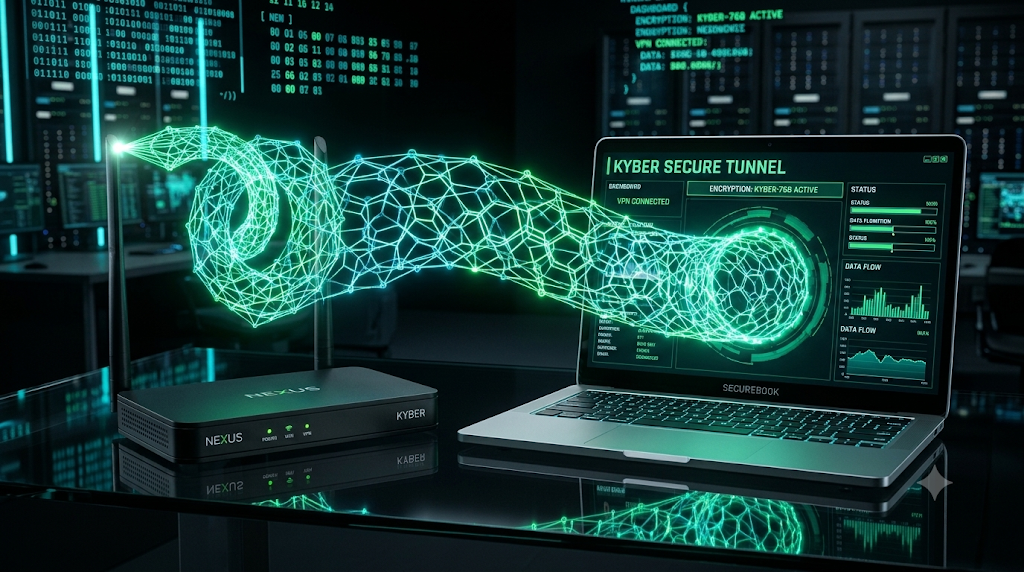
To immunize your distributed infrastructure within 2026 digital economy trends, standard WireGuard and OpenVPN tunnels are no longer sufficient. Enterprise operators must deploy a post quantum encryption remote vpn utilizing lattice-based cryptographic algorithms recently standardized by NIST.
Thanks to the finalization of the FIPS 203 standard (ML-KEM, formerly Kyber), integrating quantum-resistant cryptography into your daily workflow no longer requires an advanced degree in mathematics. Whether you are safeguarding automated datasets extracted from your n8n local LLM workflows or securing client communications over public Wi-Fi, this guide details the exact architecture and tools to upgrade your VPN tunnels to post-quantum standards today.
Quick Comparison: Classical vs. Hybrid Post-Quantum VPNs (2026)
| Cryptographic Vector | Classical VPN (WireGuard Standard) | Hybrid Post-Quantum VPN (WireGuard + ML-KEM) |
| Key Exchange Mechanism | Elliptic Curve Diffie-Hellman (X25519) | Hybrid: X25519 + ML-KEM-768 |
| Vulnerability to Quantum Computers | Critical (Shor’s Algorithm breaks ECDH in minutes) | Immune (Lattice-based cryptography resists Shor’s) |
| Current Threat Exposure | “Harvest Now, Decrypt Later” data scraping | Zero retroactive decryption risk |
| Latency & Performance Impact | Baseline (Ultra-low latency) | Negligible (+1ms to 3ms handshake overhead) |
| Recommended Implementation | Standard Linux/Mac client | Mullvad VPN (Native) or Rosenpass (Self-Hosted) |
| Hardware Requirement | Any modern CPU | Any modern CPU (ML-KEM is highly optimized) |
1. The Core Threat: Shor’s Algorithm and HNDL
To understand why a massive infrastructure upgrade is necessary, you must understand the mathematical vulnerability sitting inside every modern device.
When you connect to a standard VPN, your laptop and the VPN server use public-key cryptography (like RSA or Elliptic Curve Cryptography / ECC) to securely exchange a secret session key. This system relies on math problems that are practically impossible for classical supercomputers to solve, such as factoring massive prime numbers.
However, a functional quantum computer running Shor’s Algorithm can solve these exact mathematical problems exponentially faster. An encryption key that would take a traditional supercomputer 300 million years to crack could be shattered by a mature quantum machine in a single afternoon. If your traffic is being recorded today (HNDL), the adversary is simply waiting for the hardware to catch up.
2. The Solution: FIPS 203 (ML-KEM / Kyber)
In late 2024 and early 2025, the National Institute of Standards and Technology (NIST) finalized its post-quantum cryptographic standards. The primary standard for Key Encapsulation Mechanisms (KEM)—the process of securely establishing a shared secret key—is ML-KEM, originally developed under the project name Kyber.
- Lattice-Based Cryptography: Instead of factoring primes, ML-KEM hides the cryptographic key inside a complex, multi-dimensional geometric lattice. Even with theoretical algorithms, quantum computers cannot navigate these lattices efficiently.
- The Hybrid Approach: Because ML-KEM is relatively new, security engineers do not recommend dropping classical encryption entirely. Instead, the 2026 standard is Hybrid Cryptography. Your VPN client wraps the session key in both traditional X25519 and ML-KEM. For an attacker to break the tunnel, they would have to defeat both classical math and quantum-resistant math simultaneously.
3. How to Deploy a Post-Quantum VPN Today
You do not need to build custom software to implement this. The consumer and enterprise markets have rapidly integrated ML-KEM. Here are the two primary deployment paths for remote workers.
Path A: The Zero-Configuration Route (Mullvad VPN)
For individual freelancers and remote workers who want post-quantum security without maintaining their own Linux servers, Mullvad VPN is the undisputed industry leader.
- Native Integration: Mullvad natively integrated post-quantum WireGuard tunnels into their desktop and mobile applications.
- How to Verify: When you connect to a Mullvad server using their desktop app (macOS, Windows, or Linux), the app automatically negotiates a hybrid key exchange (
X25519 + Kyber). - Hardware Tokens: To maximize this setup, pair your encrypted tunnel with physical biometric authenticators as detailed in our guide on hardware security keys vs passkeys to ensure the device initiating the tunnel cannot be compromised by local malware.
Path B: The Self-Hosted Route (WireGuard + Rosenpass)
For agency owners, DevOps engineers, and remote startups hosting their own internal infrastructure (e.g., AWS VPCs or private Proxmox servers), standard WireGuard does not natively support Kyber yet.
To achieve post-quantum security on a self-hosted VPN, you must deploy Rosenpass.
- What is Rosenpass? Rosenpass is an open-source tool that runs alongside standard WireGuard. It handles the post-quantum key exchange using Classic McEliece and Kyber, and then feeds the resulting secure, quantum-resistant key into WireGuard every two minutes.
- The Architecture:
- Install WireGuard on your Ubuntu/Debian server and your client machine.
- Install the Rosenpass daemon.
- Configure Rosenpass to generate PSKs (Pre-Shared Keys) and inject them directly into the WireGuard interface. Even if a quantum computer breaks WireGuard’s native ECDH handshake, the injected Rosenpass PSK keeps the tunnel completely dark.
4. Performance Impact on Nomad Travel Hardware
A common concern among digital nomads is whether running next-generation cryptography will drain laptop batteries or overheat portable travel routers (like GL.iNet models).
The engineering brilliance of ML-KEM (Kyber) is its efficiency:
- Speed: ML-KEM encrypts and decrypts at speeds comparable to, or even faster than, traditional Elliptic Curve cryptography.
- Payload Size: While the mathematical keys are slightly larger (around 1,000 bytes compared to 32 bytes for X25519), the impact on a standard broadband or 5G connection is undetectable.
- Latency: Benchmarks show that a hybrid handshake adds less than
2.5 millisecondsof latency during the initial connection phase. Once the tunnel is established, symmetric encryption (AES or ChaCha20) takes over for data transfer, resulting in zero bandwidth degradation during Zoom calls or large file commits.
If your remote workstation is already configured according to modern biometric security protocols, adding a post-quantum VPN layer introduces zero operational friction.
Do not wait for quantum computers to hit the commercial market before upgrading your encryption infrastructure; by then, your historical traffic will have already been compromised. Deploying a post-quantum remote VPN in 2026 is a low-cost, zero-friction upgrade that permanently neuters “Harvest Now, Decrypt Later” surveillance. Whether you flip a toggle in Mullvad or deploy Rosenpass on your corporate Linux server, upgrading to ML-KEM/Kyber is the single highest-ROI security action a remote founder can take this year.


