


Affiliate Disclosure: FactsnFigs is reader-supported. When you purchase travel tech, hardware, or cellular data packages through links on our site, we may earn an affiliate commission at no extra cost to you.
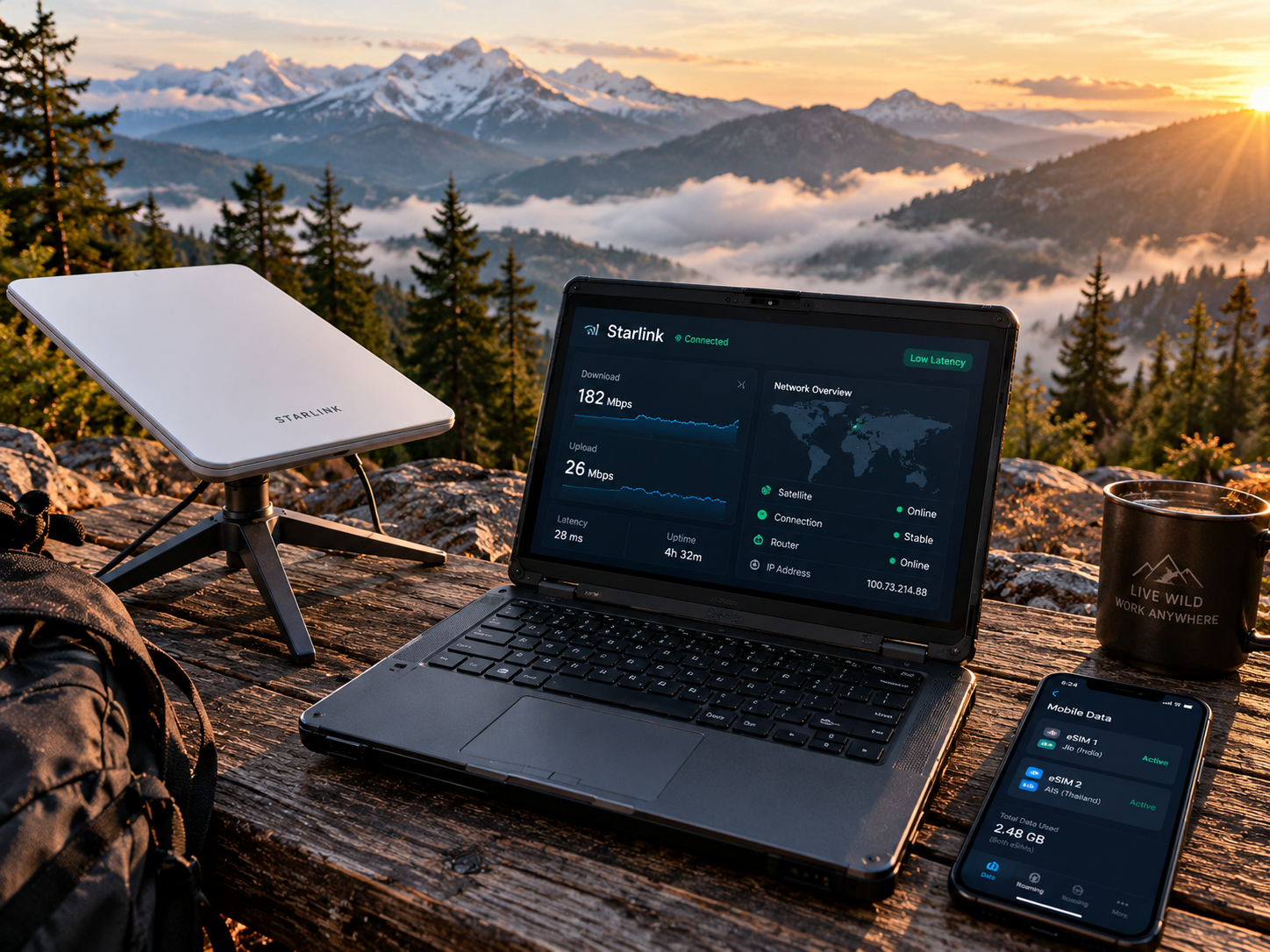
Nothing cripples a remote career faster than arriving at an idyllic coastal retreat or mountain valley only to discover that the advertised “high-speed broadband” barely loads an email inbox. For digital nomads, vanlifers, and field engineers participating in the 2026 digital economy trends, connectivity is a non-negotiable operational lifeline.
Over the past year, the remote connectivity ecosystem has bifurcated into two dominant technical approaches:
- Low Earth Orbit (LEO) satellite hardware, driven by the backpack-sized Starlink Mini with native DC power capabilities.
- High-speed multi-carrier cellular aggregation via software-provisioned travel profiles, requiring the best international eSIM for nomads 2026 to roam without local SIM card friction.
Relying on either system in isolation leaves you exposed to geographical dead spots or severe battery drains. Deploying an effective remote workstation requires understanding the operational boundaries, power requirements, and cost-per-gigabyte economics of both platforms.
Below is a direct comparison between the Starlink Mini satellite architecture and tier-1 global eSIM networks before we analyze real-world configurations.
Quick Comparison: Satellite vs. Cellular Roaming (2026 Field Data)
| Metric | Starlink Mini (LEO Satellite) | Tier-1 Global Travel eSIMs (Airalo, Holafly, Nomad) |
| Primary Advantage | 100% coverage in wilderness areas with zero cellular towers | Zero hardware weight; instant zero-touch activation in urban/suburban zones |
| Typical Speeds (DL / UL) | 50 – 150+ Mbps Down / 10 – 25 Mbps Up | 30 – 250+ Mbps Down / 15 – 50 Mbps Up (Local 5G dependent) |
| Average Latency | 28 ms – 45 ms (LEO constellation) | 35 ms – 90 ms (Depends on international roaming breakout) |
| Power Consumption | 18W – 25W steady active draw (100W USB-C PD or 12V DC) | < 1W (Native internal smartphone battery consumption) |
| Hardware Overhead | 1.10 kg (2.4 lb) dish + mount + cables + power bank | 0 grams (Virtual embedded SIM profile stored on device) |
| Monthly Operating Cost | $50 – $150+/mo (Roam plan tiers) | $15 – $45 per country/region (Pay-per-GB or 30-day buckets) |
| Obstruction Vulnerability | Critical (Requires clear 110° sky view; fail on tree cover) | None from sky; vulnerable to concrete basements and rural dead zones |
1. The Starlink Mini Breakdown: Unmetered Off-Grid Freedom
The launch of the Starlink Mini changed the nomad gear checklist permanently. Unlike earlier motorized Gen 2 units and bulky Gen 3 dishes that drew 75W–100W through heavy pure-sine-wave inverters, the Mini integrates the phased-array transceiver and Wi-Fi router into a single flat-panel package measuring just 29.8 x 25.9 cm.
[Portable LiFePO4 Power Station / 100W USB-PD Bank]
                         │
         20V / 5A Barrel Connector (DC)
                         │
                         ▼
        [Starlink Mini Integrated Panel]
                         │
           Direct Upstream LEO Handshake
                         │
                         ▼
    [100+ Mbps Low-Latency Remote Workstation]
Power Architecture in the Field
The primary engineering breakthrough of the Mini is its native 12V to 48V DC input barrel port.
- Zero Inverter Waste: Operating through a standard 12V DC vehicle circuit or a 100W USB-C Power Delivery (PD) trigger cable bypasses the 15% to 25% efficiency penalty incurred when converting DC battery power to AC and back.
- True Battery Runtime: Drawing an average of 18W to 22W during normal web tasks (peaking at 40W during continuous heavy file uploads), a compact 500Wh portable power station runs the Mini for approximately 21 to 24 hours of non-stop video conferencing and SSH sessions.
The Practical Bottleneck: Sky Obstructions
The Mini’s phased array features a 110-degree field of view. While it excels in deserts, open coastal bluffs, and agricultural valleys, dense temperate rainforests or narrow mountain canyons cause repeated satellite drops. A single pine branch cutting across the orbital sweep will cause micro-interruptions that drop Zoom calls and disrupt VoIP traffic, requiring a fallback solution.
2. Global Travel eSIMs: Agile, Lightweight Roaming
Software-defined cellular roaming remains the most efficient choice for nomads hopping across international cities, train corridors, and transit hubs. Modern smartphones support multiple active eSIM profiles simultaneously, allowing you to switch cellular routing without physically swapping fragile plastic cards.
In evaluating the market, three distinct service tiers have emerged:
Airalo: The Multi-Hop Standard
Airalo is the most established eSIM marketplace, offering individual country packages (such as Eurolink for 39 European countries or Asialink).
- The Routing Advantage: Airalo agreements partner with tier-1 localized telcos (e.g., Orange in France, O2 in the UK, Singtel in Singapore).
- Latency Profile: Regional eSIM profiles often route traffic through centralized gateway hubs. For example, using an Asian regional profile while working in Japan may route traffic via Singapore, introducing an extra 40ms to 60ms of ping latency. Choosing a single-country profile resolves this routing loop.
Holafly: The Heavy Bandwidth Consumer
If your daily workflow involves uncompressed 4K video asset transfers, continuous cloud syncing, or constant YouTube uploads, pay-per-gigabyte limits feel restrictive.
- Unlimited Data Models: Holafly focuses on fixed-day unlimited data passes (5 to 90 days).
- The Fine Print: Holafly enforces fair-usage policies (FUP) through local partner networks. If you consume more than 5GB to 8GB of high-speed data within a 24-hour window, local telcos will throttle throughput down to 3G speeds until midnight. Hotspot sharing is also restricted or capped on select destination profiles.
Nomad: The Flexible Hybrid Alternative
Nomad provides regional and global plans with competitive pricing per gigabyte in North America and Asia, combined with in-app top-ups that do not require installing a new ICCID profile every time your balance runs low.
For a comprehensive destination-by-destination breakdown of roaming telco alliances, refer to our best eSIM for travel guide.
3. Cost-per-Gigabyte Economics: When Does Satellite Make Financial Sense?
To decide which investment makes sense for your travel itinerary, compare the true financial outlay based on monthly data consumption:
| Work Profile | Monthly Data Usage | Recommended Primary Tool | Estimated Monthly Budget |
| Light Consultant (Email, Docs, Slack, Light Voice Calls) | 15 GB – 30 GB | Regional eSIM (Airalo / Nomad) | $25 – $45 / month |
| Heavy Specialist (Figma, Large Git Commits, Daily Zoom Calls) | 80 GB – 150 GB | Dual eSIM Stack + Local Coworking Wi-Fi | $70 – $110 / month |
| Wilderness Remote Worker (Vanlife, Isolated Villas, Off-Grid Cabins) | 200 GB – 500 GB+ | Starlink Mini (Direct DC Setup) | $50 – $150 / mo + $599 Hardware |
If you stay primarily in urban hubs, purchasing a Starlink Mini hardware kit and paying recurring monthly Roam fees represents unnecessary capital expenditure. However, the moment your travel route diverges more than 40 kilometers outside commercial cellular tower coverage, the Starlink Mini pays for itself immediately by preventing lost client billable hours.
4. The 2026 Redundant Field Architecture: The Hybrid Failover
Professional remote contractors who cannot afford a single dropped client presentation implement a multi-wan failover setup.
Using a pocket-sized dual-WAN travel router (such as a GL.iNet Beryl AX or Slate AX), you can combine satellite and cellular connections into a single resilient local network:
                  ┌── [Primary WAN: Starlink Mini Ethernet] ──┐
                  │                                           │
[Work Laptop] ────► [GL.iNet Travel Router (OpenWrt / Failover)]
                  │                                           │
                  └── [Backup WAN: Smartphone USB Tether eSIM] ┘
- Primary Interface: The Starlink Mini connects to the travel router’s WAN port via an RJ45 Ethernet patch cable (using the Mini’s weather-sealed latching Ethernet jack), providing high-bandwidth, unmetered internet for the entire workstation.
- Secondary Interface: A smartphone equipped with an active regional travel eSIM is tethered to the router via USB.
- Automated Mwan3 Failover: The router pings a public DNS server (
1.1.1.1) every 3 seconds. If tree cover or satellite switching causes a 4-second drop on the Starlink dish, the travel router switches network routes to the cellular eSIM automatically without severing active WebSockets or ending your client call.
5. Pre-Travel Hardware Checklist for Off-Grid Productivity
Before packing your bags for a remote season, ensure your mobile tech kit contains these essential items:
- Starlink Mini DC Barrel to USB-C PD Cable: Enables you to run your satellite dish directly off any 100W-rated portable battery bank without carrying proprietary AC power bricks.
- High-Capacity LiFePO4 Power Station: A 256Wh to 512Wh battery pack offers the best balance between airline carry-on limits and multi-day off-grid power endurance.
- Two Pre-Installed eSIM Profiles: Always install a global fallback profile before boarding your flight. Having an unactivated profile ready in your device settings eliminates airport Wi-Fi captive-portal friction upon arrival.
- Compact Suction or Magnetic Mount: Allows you to position the Starlink Mini securely on an RV sunroof, rental car window, or balcony railing to clear ground-level obstructions.
The debate between satellite internet and global eSIMs is not an either/or dilemma—it is an exercise in operational redundancy. If your itinerary involves international cities, cross-border train journeys, and rapid border hops, a regional multi-carrier eSIM is the most cost-effective, featherweight connectivity tool available. But if your vision of location independence involves absolute geographic freedom far beyond the reach of cell towers, the Starlink Mini is the single best piece of nomadic hardware engineered this decade. Pack both, configure automated failover, and you will never worry about a dead zone again.


