


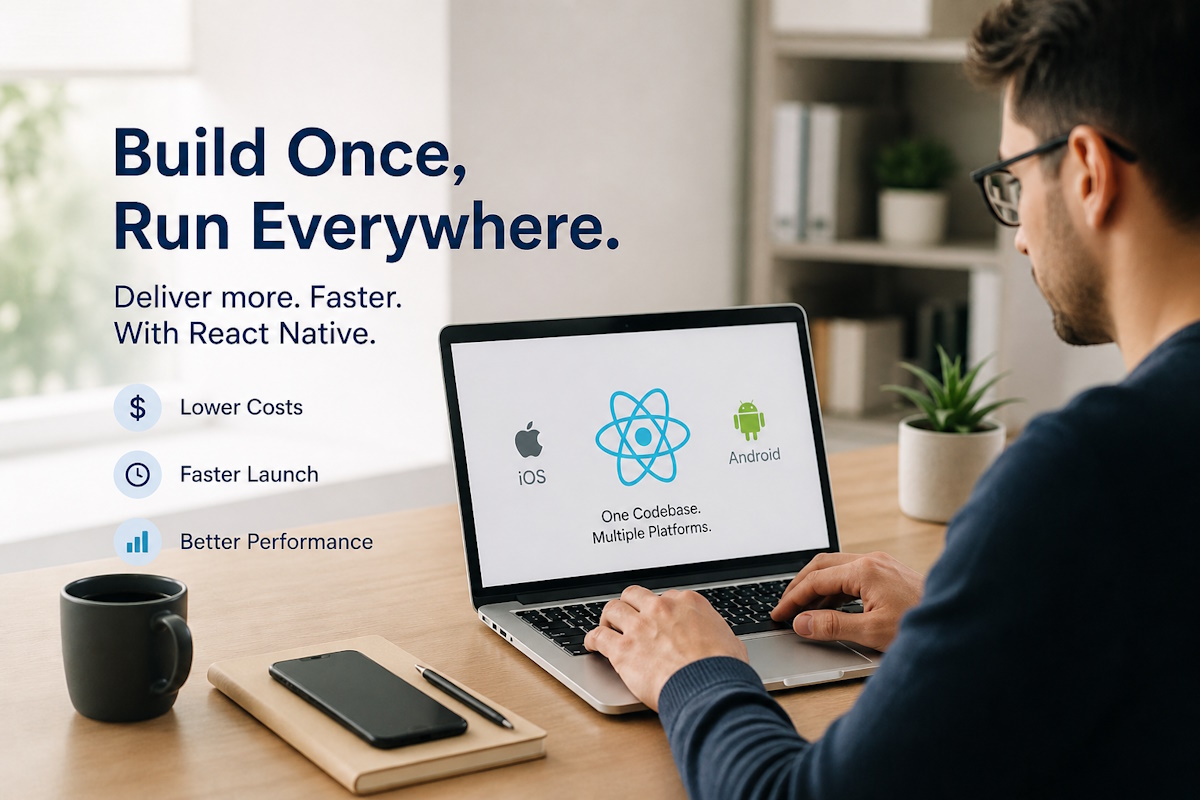
The shift is real, and it’s picking up pace
If you’ve been watching how apps are built lately, you’ve probably noticed something. Companies are no longer stuck choosing between iOS or Android first. They want both. And they want it fast.
That’s where React Native starts getting serious attention.
In 2026, more businesses are leaning toward this approach, not because it’s trendy, but because it solves real problems. Budget limits, tight timelines, and the need to stay competitive. These aren’t new issues, but the way companies handle them has changed.
Let’s break down why this shift is happening and what it actually means for you.
One codebase, fewer headaches
Building separate apps for iOS and Android used to be standard. Still is, in some cases. But it’s expensive and slow.
With React Native, you don’t need to maintain two completely different codebases. A single shared code handles most of the work.
That doesn’t mean everything is identical. Some platform-specific tweaks are still needed. But overall, the workload drops.
Think about it.
Fewer developers needed.
Less testing duplication.
Simpler updates.
That’s a big deal when you’re trying to move fast without burning through your budget.
Speed matters more than ever
Time to market isn’t just a buzz phrase anymore. It directly affects how well your product performs.
If your app takes too long to launch, someone else fills that gap.
React Native helps cut development time. Not by magic, but by reducing repetitive work. Developers can reuse components, share logic, and skip rebuilding everything from scratch.
Updates also roll out faster. You don’t always need full app store approvals for small fixes.
That speed adds up over time.
Cost control without cutting corners
Let’s be real. Budget always plays a role.
Hiring two separate teams for iOS and Android can get expensive fast. Salaries, coordination, testing, and maintenance all double up.
This is where many businesses start looking for React Native App Development Services Hire React Native Developers as a combined solution.
Instead of splitting resources, they focus on one skilled team that can handle both platforms. It’s not about spending less just to save money. It’s about spending smarter.
You still get quality. You just avoid unnecessary duplication.
Performance is no longer a deal-breaker
There was a time when people questioned whether React Native apps could perform well.
That concern has faded quite a bit.
Modern improvements have made apps smoother, faster, and more reliable. For most business use cases, the difference between native and React Native isn’t noticeable to the end user.
Sure, highly complex apps like heavy gaming or deep system-level tools might still need full native development. But for eCommerce, social platforms, booking apps, and internal tools, React Native does the job well.
And that’s what most businesses care about.
Easier maintenance, fewer surprises
Maintaining apps can get messy. Bugs show up, features need updates, and operating systems change.
When you have two separate codebases, every fix needs to be applied twice. That increases the chance of inconsistencies.
React Native reduces that risk.
A single update can reflect across both platforms. Teams spend less time chasing bugs and more time improving the app.
It also makes scaling easier. Adding new features doesn’t feel like starting from zero every time.
Strong developer community
One underrated advantage is the developer ecosystem.
React Native has a large and active community. That means better libraries, more tools, and quicker solutions when issues pop up.
Developers don’t have to reinvent everything. They can build on what already exists.
For businesses, this translates to faster problem-solving and more reliable development cycles.
And when you decide to expand your team, finding experienced developers isn’t as difficult as it used to be.
Flexibility that fits different business models
Not every business works the same way.
Some need a quick MVP to test an idea. Others want a full-scale product ready for thousands of users.
React Native supports both.
You can start small. Launch early. Then keep improving.
Or go big from day one with a well-planned architecture.
That flexibility is one reason startups and established companies both use it.
Better user experience without overcomplication
Users don’t care what technology you use. They care about how your app feels.
Is it fast?
Is it easy to use?
Does it crash?
React Native helps deliver a smooth experience without making development overly complex.
UI components can be customized to match platform standards. Apps still feel native to users.
So you don’t have to compromise on experience just to save time or cost.
Easier team collaboration
When teams work on separate platforms, coordination can get tricky.
Different timelines. Different issues. Different priorities.
With React Native, teams work on a shared foundation. Communication improves. Progress becomes easier to track.
Designers, developers, and testers stay more aligned.
That might sound like a small benefit, but it makes a big difference over time.
Frequent updates without disruption
Apps aren’t static anymore. They evolve constantly.
Users expect regular updates. Bug fixes. New features.
React Native allows quicker updates without disrupting the entire system.
Developers can push improvements faster. Businesses can respond to user feedback more quickly.
And that keeps your app relevant.
Ideal for startups and growing businesses
If you’re just starting out, resources are limited.
You need to validate your idea before spending too much.
React Native helps you build a functional app without stretching your budget too thin.
You can launch, test, gather feedback, and adjust.
Even as your business grows, you don’t necessarily need to switch technologies. React Native can scale with you.
Big brands are already on board
This isn’t just a startup trend.
Large companies are also using React Native for various projects. That says a lot about its reliability.
When businesses at that level trust a framework, it builds confidence for others.
It shows that the approach works not just in theory, but in real-world scenarios.
When React Native might not be the best fit
It’s not perfect for everything.
If your app relies heavily on advanced graphics or deep hardware integration, native development might still be the better choice.
Also, if you already have separate native apps with large teams, switching might not always make sense, even if you plan to Hire React Native Developers for new features or updates.
But for most standard business applications, React Native checks all the right boxes.
So, what does this mean for you?
If you’re planning to build an app in 2026, you have options.
The question is not whether React Native is good or bad. It’s whether it fits your goals.
Ask yourself:
Do you need to launch quickly?
Are you working with a limited budget?
Do you want one team instead of two?
Do you expect frequent updates?
If the answer to most of these is yes, then React Native is worth considering.
The smarter way forward
Choosing the right development approach can shape your product’s success.
React Native isn’t just about saving time or cost. It’s about building efficiently without sacrificing quality.
That’s why more businesses are moving in this direction.
They’re not chasing trends. They’re making practical decisions.
And that’s what sets successful products apart.
So, what’s your next move going to be?


