


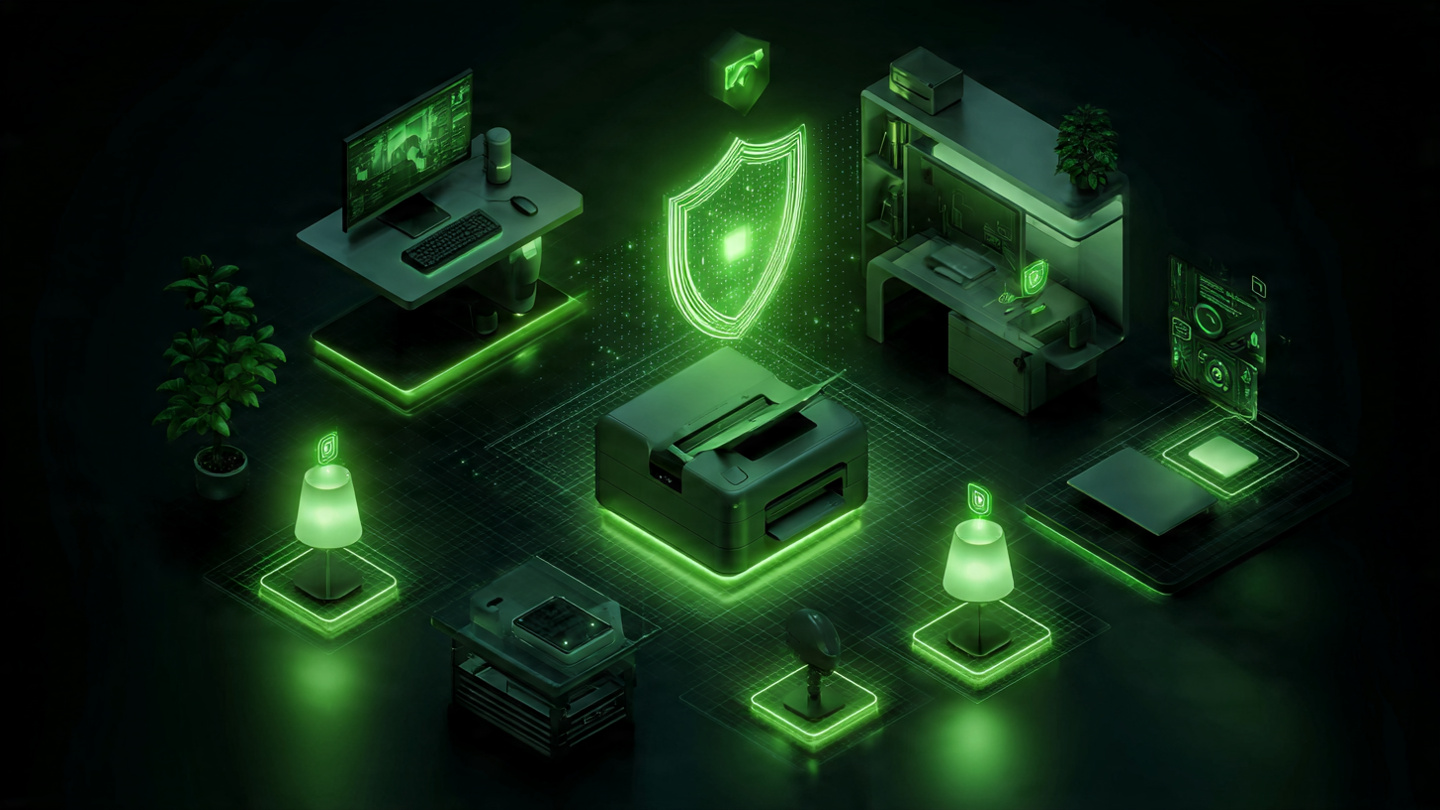
In 2026, the “Home Office” is no longer just a laptop and a chair; it is a complex ecosystem of connected devices. From smart lighting that adjusts to your circadian rhythm to AI-powered voice assistants, your workspace is more “intelligent” than ever. However, this intelligence comes with a price: Vulnerability. At FactsnFigs, our mission of Bridging Future-Tech with Real-World Utility requires us to address the “invisible” threats lurking in your network.
Securing your Digital Nomad Infrastructure starts with the realization that every “Smart” device is a potential doorway for an attacker. This is Where Data Meets Decision.
The 2026 IoT Landscape: Why Your Printer is a Target
By 2026, the number of IoT devices globally has crossed 30 billion. Most of these devices—like smart thermostats or coffee machines—are built for convenience, not security. They often lack the processing power for heavy encryption, making them the “weakest link” in your professional setup.
According to the 2026 Global Digital Trust Insights, 41% of security leaders cite a lack of network segmentation as their top challenge. When you work from home, your AI Project Management Tools and sensitive FinTech data live on the same Wi-Fi as your smart fridge. If the fridge is compromised, the hacker can move “laterally” to your laptop. This is why Securing IoT Devices for Home Offices in 2026 is a strategic necessity.
The Sameer Shukla Protocol: 5 Steps to a Fortified Office
To achieve Future-Tech Utility without sacrificing safety, I recommend a proactive, “Assume Breach” mindset.
1. Implement Micro-Segmentation
Don’t put all your eggs in one basket. Use your router’s settings to create a separate VLAN (Virtual Local Area Network) specifically for IoT devices.
- Real-World Utility: Your work laptop and eSIM-connected devices should be on one network, while your smart TV and lights are on another. If the TV is hacked, the attacker is “trapped” in that segment.
2. Zero-Trust Architecture (ZTA)
Adopt the principle of “Never Trust, Always Verify.” In 2026, ZTA is the gold standard. Every device must prove its identity before communicating.
- Action: Ensure your Zero-Trust Security protocols extend to your smart hardware, not just your software.
3. Kill the Defaults
It sounds simple, but 60% of IoT breaches in 2025 were due to default passwords.
- Sameer’s Tip: The moment you unbox a new device, change the admin credentials. Use a dedicated password manager to keep these complex, unique keys safe.
4. Firmware Vigilance (The “Patch or Perish” Rule)
IoT manufacturers often release security patches to close “Zero-Day” vulnerabilities.
- Future-Tech Utility: Enable “Auto-Update” on every device. If a device hasn’t received an update in over 12 months, it is a liability. Consider replacing it with a future-proof alternative.
5. Disable UPnP and WPS
Universal Plug and Play (UPnP) and Wi-Fi Protected Setup (WPS) are designed for ease of use but are notoriously easy to exploit. Turn them off in your router settings to prevent unauthorized external access.
Bridging Future-Tech with Real-World Utility: The Hardware Check
As Digital Saiff mentioned in his guide on Ergonomic Setups, your gear must serve you. In 2026, this includes your router. If you are still using the router provided by your ISP, you are likely missing out on advanced AI-driven threat detection.
Investing in a Cyber-Hardened Router is a key part of your Digital Nomad Infrastructure. Look for features like:
- On-Device AI Analytics: To detect anomalous behavior in real-time.
- Hardware-Level Encryption: To secure data before it even hits the 6G network.
The “Human Factor”: Behavioral Security
Even the best Digital Nomad Infrastructure can be bypassed by a human error. As you learn Generative AI, be wary of “AI-enhanced” phishing attempts that might ask for your IoT control credentials.
At FactsnFigs, we believe that Where Data Meets Decision, the human must be the final firewall. Regularly audit your connected devices. If you no longer use that “Smart Coffee Maker” from three years ago, unplug it. An inactive device is an unmonitored back door.
Conclusion: Security as a Foundation for Growth
Securing IoT Devices for Home Offices in 2026 is not about living in fear; it’s about building a foundation for growth. When your network is secure, you can focus your energy on the Rise of Solopreneurship and scaling your business.
By Bridging Future-Tech with Real-World Utility, we empower you to use the best tools available without becoming a statistic in a data breach report. Protect your data, protect your hardware, and always make the informed decision. Because here, Where Data Meets Decision, your safety is our priority.


